

- Inicio

- Postgraduates
- Doctorates
- Escuela de Ciencias Básicas
- Doctorate in Biomedical Sciences
Faculty of Health


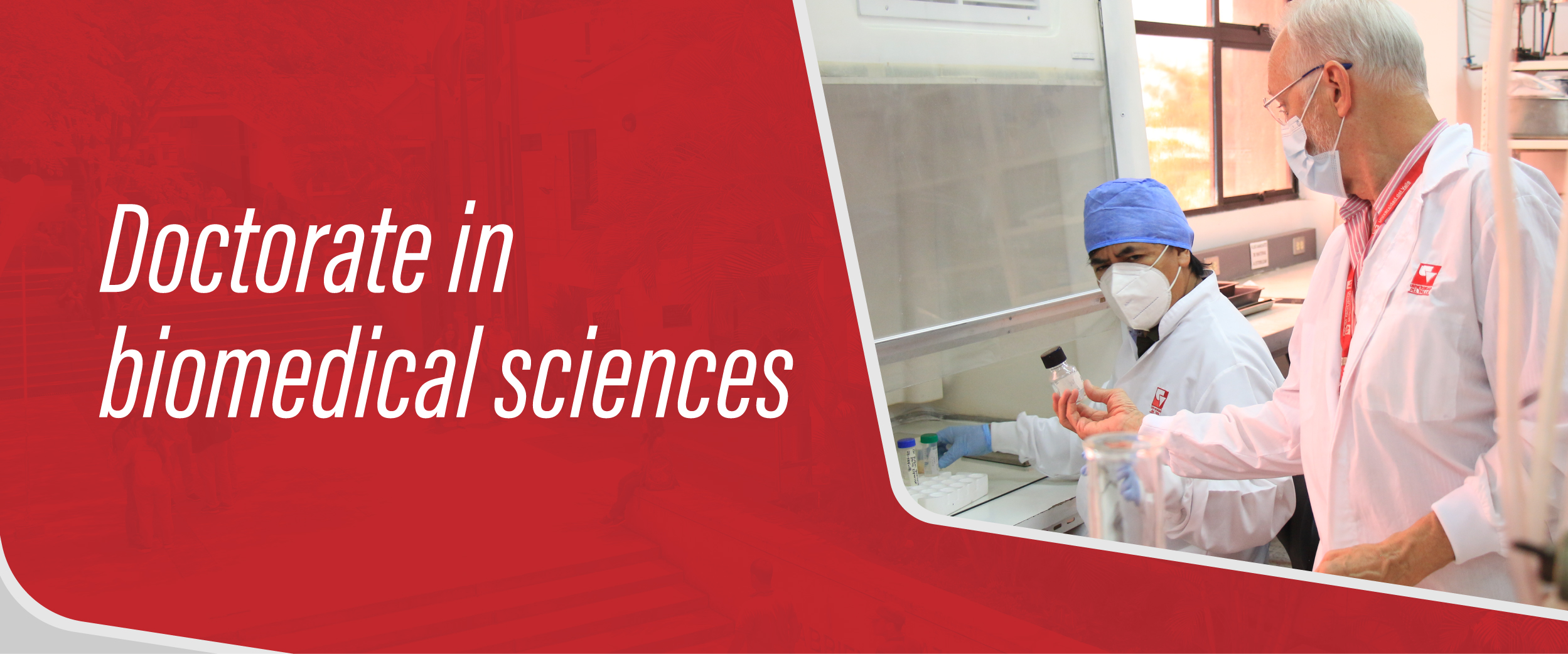
Doctorate in Biomedical Sciences
| 670 | |
| Res.10426, issued on May 22, 2017, for a period of 7 years | |
| Acreditation | Res. 021332, issued on November 11, 2020, for 6 years |
| In person | |
| Day | |
| 8 Semesters | |
| 94 | |
| 12 | |
| Cost per Semester | 7.5 SMMLV |
| Title that grants | Doctor in Biomedical Sciences |
| School of Basic Sciences | http://cienciasbasicas.univalle.edu.co |

Train researchers capable of organizing and directing biomedical research with integrity, responsibility, transparency and rationality, which contribute to the development of science, health and well-being of the country and the region.
The Academic Doctorate Program in Biomedical Sciences aims to train researchers and scientific leaders with the ability to autonomously carry out and guide investigative and academic processes in the area of Biomedical Sciences.
Professional Profile
The graduate of the Doctorate in Biomedical Sciences will be able to:
- Critically analyze the biomedical scientific literature and critically appropriate the theoretical knowledge and management of the methods used to support the generation of biomedical knowledge.
- Autonomously carry out multi, inter and trans-disciplinary biomedical research within research groups, institutions providing health services and companies in the biomedical sector..
- Lead work teams capable of contributing to the solution of academic and professional problems in biomedical sciences.
- Work in scientific, technological and teaching activities related to biomedical sciences.
- Understand your ethical and professional responsibility and frame all your actions within these principles.
- Perform adequately in the socio-economic environment of the country, also understanding the impact of their work in a globalized dimension.
Occupational Profile
The graduate of the Doctorate in Biomedical Sciences will be able to be linked to research in secondary education, higher education, research institutes and entities that finance research programs and projects.
Enrollment requirements
The Registration and Admission Process is carried out taking into account the dates and procedures established by the academic calendar issued by the Academic Vice-Rector's Office, in addition to the specific dates and procedures established by the Academic Program.
For each open call, the maximum number of new admitted students may not be greater than 6 nor less than 1. If the Academic Program does not complete the established minimum quota, it will not be able to begin academic activities in that period, in which case, the admitted applicants they will keep the quota only until the next admission call in which the quota is filled.
Applicants may register for only one research group, which they must indicate in their registration form. Applicants are recommended to contact the Research Groups of the School of Basic Sciences before registering.
 Consult HERE the process of admission for the program of Doctorate in Biomedical Sciences.
Publication of results:
The Admissions Office of the Division of Admissions and Academic Records of the Universidad del Valle, will publish the final results as indicated in the current academic calendar. Academic calendars and other information regarding the application and admission process to the Universidad del Valle graduate programs can be found on the web http://admisiones.univalle.edu.co
The curriculum of the Biomedical Sciences Doctoral Program is flexible, individualized, and research-focused. It is credit-based and structured into three components:
- Basic component (12 credits). Aimed at providing the basic theoretical and methodological foundation necessary to conduct biomedical research.
- Advanced Research Component (66 credits). Focused on providing the practical and methodological foundations necessary to conduct cutting-edge biomedical research. Students will be trained in critically analyzing the scientific literature relevant to their research area and in effectively communicating their research findings both in writing and orally.
- Componente electivo (12 créditos académicos). Orientado a proporcionar fundamentación teórica y metodológica para apoyar el desarrollo del componente investigativo del Programa. Estas asignaturas son definidas por el tutor de cada estudiante, de acuerdo con las necesidades de formación académica que requiera para el desarrollo de su proyecto de investigación.
Para optar al título de Doctor en Ciencias Biomédicas se requiere:
- Complete and pass a minimum of 90 academic credits.
- Students must have passed all courses and program-specific activities with a cumulative GPA of at least 70% of the current grading scale. In no case may the overall weighted average be less than (3.5).
- To be a doctoral candidate, which requires passing the qualifying examination.
- To have developed, presented, support and successfully defended a doctoral dissertation.
- Have published or had an original research article accepted for publication in an indexed scientific journal. The article must be about a chapter, chapters, or part of a chapter of the doctoral dissertation and the student must be the first author of it.
- To have fulfilled all financial, academic, and administrative obligations to the Program and the University.
- Have been a regular student of the Program at the Universidad del Valle for the minimum time established by the general postgraduate regulations that are in force.
- To have passed the advanced English language exam administered by the School of Language Sciences at the Universidad del Valle with a minimum score of 60% on the current grading scale.
- Comply with the other requirements stipulated in the current regulations that the Universidad del Valle has for its doctoral programs.
The School of Basic Sciences was formed in 1994, with the aim of promoting the integration of teachers and students from different basic disciplines in the health area. It currently has two postgraduate academic programs: Master in Biomedical Sciences and Doctorate in Biomedical Sciences and is made up of three Departments:
- Department of Morphology (Histology, Anatomy, Embryology and Genetics).
- Department of Physiological Sciences (Biochemistry, Cellular and Molecular Biology, Physiology and Pharmacology)..
- Department of Microbiology (Bacteriology, Immunology, Mycology, Parasitology and Virology).
Postgraduate studies in the areas of Basic Sciences of the Faculty of Health have operated uninterruptedly at the Universidad del Valle since 1955 and appeared related to the undergraduate program in Medicine and Surgery. At the beginning, these were simply attempts to deepen knowledge in some fields of these sciences at the postgraduate level, without any degree being awarded.
In 1967, twelve years later, through Agreement 005 of the Superior Council of the Universidad del Valle, the first Master's programs leading to degrees in the areas of Biochemistry, Pharmacology, Physiology, Microbiology, Morphology and Pathology were created; and PhD in Biochemistry, Physiology, Pharmacology and Pathology.
In 1978, through Resolution 498 of the Board of Directors, the Universidad del Valle issued its first Regulations for Postgraduate studies at the University. In 1988, through Resolution 031 of the Academic Council, specific regulations were issued for Doctorate plans at the Universidad del Valle.
Through Resolution 076 of May 14, 1990 of the Academic Council, the curricular structure of the Doctorate Study Plan in Biomedical Sciences was defined for the first time and through Resolution 061 of May 21, 1990, the Superior Council created the study plan of Doctorate in Biomedical Sciences at the Universidad del Valle. In 1994, the Doctorate Program was visited by an Evaluation Commission formed by the ICFES, which recommended modifying the curricular structure of the Doctorate in Biomedical Sciences study plan. As a result, the Academic Council of the Universidad del Valle issues Resolution 079 of June 30, 1994, which modifies Resolution 076-CA of 1990. However, considering that the Ministry of National Education issued Decree 2791 On December 22, 1994, the Academic Council of the Universidad del Valle issued Resolution 044 of December 18 April 1996, modifying Resolution 079-CA of 1994.
In 2008, the Program underwent a self-evaluation process; as a result, Resolution 112 of November 19, 2009 of the Academic Council was issued, modifying Resolution 044-CA of 1996..
|
Regulations
Law 1740 DEL 2014
Doctorate Regulations in Biomedical Sciences
Resolution Mentions
Curriculum Resolution Doctorate in Biomedical Sciences
Qualified Registration Doctorate in Biomedical Sciences
Resolution Registration and Admissions Process
Thesis Project Guide
Formats
Seedbed Evaluation Research - Club Magazines
Evaluation Research - Research Works - Thesis Continuation
Interview Format
Knowledge Exam Format
Academic Programming Format
Medical Service Waiver Form
Late Registration Request