




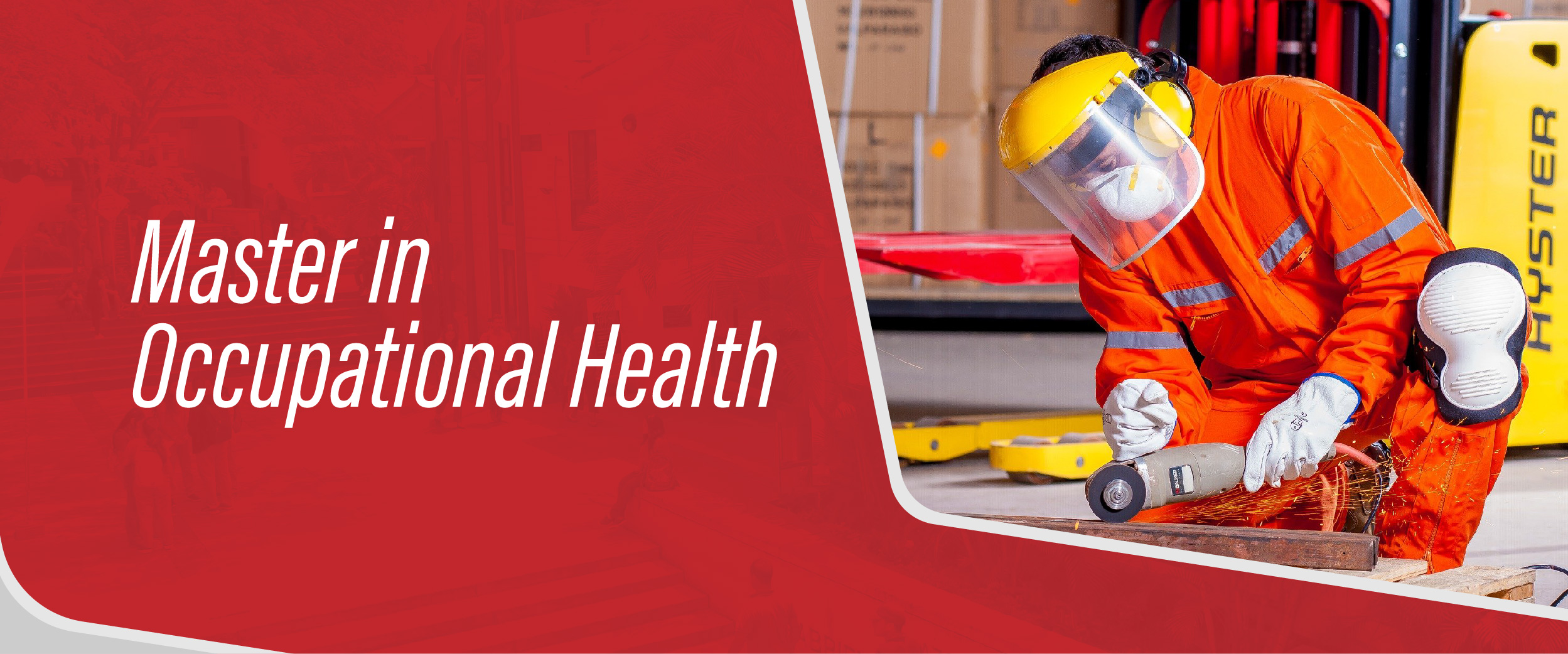
Master in Occupational Health
| 655 | |
| Res. No. 005265 of April 7, 2022 for 7 years | |
| Accreditation | Res. 21331 of November 11, 2020 for 4 years |
| In person | |
| Day. Every two weeks. Friday: 1:30 p.m. a 9:30 p.m. Saturday: 8:00 a.m. a 4:00 p.m. |
|
| 4 Semesters | |
| 52 | |
| 20 | |
| Cost per Semester | 5.25 SMMLV |
| Master in Occupational Health | |
| School of Public Health | http://saludpublica.univalle.edu.co/ |

Train master professionals who contribute to the construction of the best operating environment, in companies of all economic activities so that they protect the working population from the risks derived from work activities, using appropriate industrial hygiene and safety measures, occupational medicine. , preventive medicine, ergonomics, psychology, basic sanitation, and the operation of Occupational Health programs, currently known as the Occupational Health and Safety Management System (SG-SST) in the formal and informal sector of the economy taking into account the commitment of companies to sustainable development and productivity.
Specific
- Use the concepts of Modern Administration to plan, coordinate, direct, execute and evaluate actions related to research in Occupational Health.
- Emphasize the teaching of the scientific method applied to the field of Occupational Health, to develop research that refers to the working conditions of the working population and its interrelationships with the operational and general environment.
- Train students in the application of the epidemiological surveillance method in studies and research related to Occupational Health.
- Train students in the prevention of occupational illnesses and accidents through the early detection of occupational pathologies and work-related conditions.
- Teach the interpretation of current legal regulations on Social Security and Occupational Health in the country.
- Train the student in knowledge of the bio-psycho-social situation of the worker in relation to the organization of work and man-work interaction.
- Teach the fundamental elements of toxicology.
- Possess a professional title.
- Accredit professional and investigative activities.
- Complete the registration form correctly and accompany it with the documents required by the Universidad del Valle for registration in Postgraduate programs.
- Present and approve an essay referring to your study expectations.
- Present interview.
Professional Profile
At the end of the Unit the professional participant will be able to:
- Promote knowledge of actions, promotion, prevention, protection, early screening and rehabilitation of workers in their work environment.
- Define the characteristics of the SG-SST, the allies, the benefit plans and the operating conditions of the system.
- Provide basic concepts, methods, techniques, strategies and materials through basic knowledge of sanitation and intervention, in aspects related to psychosocial factors and risks in the context of the SG-SST team (Health and Safety and Management System). at Work) in the Productive Units.
- Provide basic knowledge of Environmental Sanitation and the risk approach to generate inputs in the management of actions, programs or projects aimed at improving the living conditions of urban and rural sectors in the wide spatial distribution of the country's human ecosystems and is special to the work centers.
- Know the role of epidemiology, demography and statistics in Occupational Health through recognition of its foundations, methodology used and its application in the prevention and control of occupational health and public health problems.
- Integrate management concepts and tools for the continuous improvement of the basic processes of the programs and activities in Occupational Health in the SG-SST and Prevention of Professional Risks.
- Define a research problem, propose general and specific objectives to investigate that problem and begin reviewing its theoretical framework.
- Design an Epidemiological Surveillance Protocol in Occupational Health (VESO) for the identification and control of environmental risk factors, with the active participation of the Company and its workers. The role of public policies in their relationship with health economics issues.
- Discover the importance of ethics and bioethics in Occupational Health.
- Obtain, analyze, interpret, disseminate and use information that is relevant, reliable, and timely for decision-making at different institutional levels and categories, in order to base decision-making with scientifically valid, culturally and socially acceptable information, administratively feasible, that articulates the production of knowledge and information to health policies and interventions.
- Promote the development of research to identify factors associated with the health-work relationship, to design and apply alternatives for sectoral and intersectoral participation in the face of occupational health problems.
Occupational Profile
- The professional of the Master's Degree in Occupational Health is trained in the comprehensive, conceptual and practical management of the health situation of workers in relation to their work performance in the companies that are part of the different economic activities of the formal and informal sector.
- The emphasis in its performance is on the design and execution of research projects on working conditions of the working population, risk factors and prevention and control measures.
- They are able to design, advise and direct public, private and community entities, in the definition of Occupational Health policies, advise companies, unions and workers. Also manage professional risk prevention programs and direct Occupational Health programs in companies.
- Has mastery in the interaction between man and work environment. It has the opportunity to determine impacts to both the general and operational environment in the legal framework of the country's environmental and occupational legislation.
First Semester
- Generalities of Occupational Health and Social Security - Credits 4
- Sociology of work and work psychology - Credits 1
- Sanitation - Credits 1
- Epidemiology-Demography-Biostatistics - Credits 6
Second Semester
- Occupational Health Fundamentals - 5 Credits
- Occupational medicine-prevention in an operational environment - Credits 3
- Professional Risk Administration - Credits 1
- Research Methodology I - Credits 2
- Epidemiological surveillance - Credits 2
Third Semester
- Public policies and legislation in occupational health - Credits 3
- Research Methodology II - 5 Credits
- Project formulation and management - Credits 2
- Managerial and pedagogical skills in occupational health - 2 Credits
Fourth Semester
- Research Methodology III - 4 Credits
- Social and economic evaluation in health - Credits 2
- Bioethics - Credits 1
- Field work in Teaching and Professional Risks - Credits 2
- Research Work - 6 Credits
- Fill out the "Degree Application" form.
- Enlarged photocopy of the Identity document.
- Photocopy of Diploma or Undergraduate Degree Certificate.
- Graduate Card Application Form.
- Original Payment Receipt "Grade Rights".
- Peace and Safe.
- Take an English proficiency exam.
The Master's Degree in Occupational Health at the Universidad del Valle was established in 1991 by Agreement No. 105/91. It has been operating in the School of Public Health, which is part of the Faculty of Health of the Universidad del Valle.
At that time, the fortunate coincidence occurred that two distinguished part-time professors of the Department of Social Medicine, experts in Occupational Medicine with courses in Chile and Bogotá, Doctors Jorge Paredes Montoya and Carlos Osorio Torres, were at the same time senior officials of Social Security, assigned to the Occupational Health Division of that entity in the Valle Section based in Cali.
The location of these two officials meant that both had a clear awareness not only of the problems that arose between workers and their employers but also of their growing magnitude and the impact on the health of workers of both sexes and the communities. In general, there was no immediate solution in sight due to an almost absolute lack of professional personnel trained in occupational health.
Studies were then begun in order to structure an academic curriculum, for which a curriculum design committee was formed made up of medical professors Jorge Paredes and Carlos Osorio from the Department of Social Medicine and environmental engineer Adolfo Bolaños from the Faculty of Architecture. but closely linked to Social Medicine for several years, a committee that had to consult several factors. One was the duration of the studies, which could not be less than three semesters because it was not permitted by the University's regulations for programs leading to the Master's degree, nor by its own officials, who could free up part of their work time to that they attend to their studies but not for more than the three regulatory semesters for other postgraduate programs.
After having obtained the appropriate requirements and even approval from the University itself to develop this new postgraduate degree with the support of the University of Alabama at Birmingham (UAB) of the United States of America, training decent people both in Cali and at the UAB, in topics related to Occupational Health; It was submitted to the approval of the highest national authority, the Institute for the Promotion of Higher Education ICFES, and after such request had been made in 1988, it was only on August 9, 1991 that the ICFES sent the report to the university. approval of the Master's Program in Occupational Health.
Thus, the Master's in Occupational Health program of the School of Public Health of the Universidad del Valle was approved, having met all legal and academic requirements (Henao Cabal, 1996).
|
Regulations