



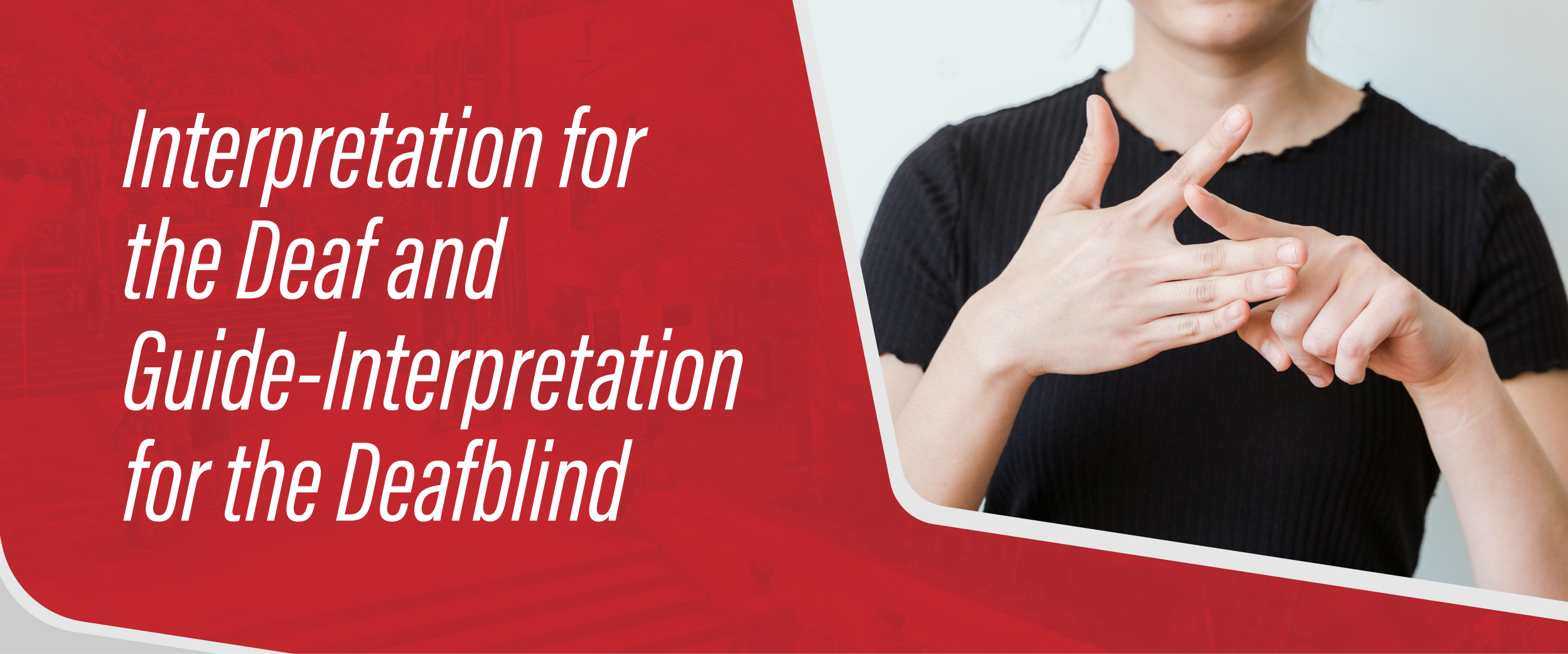
Interpretation for the Deaf and Guide-Interpretation for the Deafblind
| 109921 | |
| Resolution 2579 of February 19, 2021 | |
| In person – 20% virtual | |
| Evening | |
| 8 Semesters | |
| Tittle that grants | Interpreter for the Deaf and Interpreter Guide for the Deafblind |
| 138 | |
| 30 | |
| Esta dirección de correo electrónico está siendo protegida contra los robots de spam. Necesita tener JavaScript habilitado para poder verlo. |
The undergraduate degree in Interpreting for the Deaf and Guide-Interpreting for the Deafblind is an interfaculty academic program, in which the Faculty of Humanities through the School of Language Sciences and the Faculty of Health through the School of Human Rehabilitation of the Universidad del Valle. |
Academic Calendar
Check information about admission dates and requirements at: https://admisiones.univalle.edu.co/
The Academic Program Interpretation for the Deaf and Guide-Interpretation for the Deafblind is the product of the accumulated training experience of the Universidad del Valle in interpreter certification processes and the training of Technologists in the field of interpretation and guide-interpretation since the nineties. The professional university training offered in this Academic Program will continue to contribute to the qualification of non-certified interpreters and guide-interpreters in practice, and of people with a command of Colombian Sign Language (LSC) and Spanish, who are interested in training in the field and contributing to the creation of conditions of participation and accessibility to information and communication for Deaf and Deafblind people in society.
General Objective
To train professionals in interpretation, in Colombian Sign Language (LSC) and Spanish, for the deaf and in interpreting guides for the deafblind, to enable interlinguistic and intercultural contact between these communities and mainstream society, thus contributing to the full and autonomous participation of these populations within the framework of a democratic society.
Specific Objectives
- Promote the development of advanced linguistic and communicative skills in LSC and Spanish.
- Provide opportunities for the recognition and management of communication systems privileged by the Colombian deafblind community and for the knowledge of the specificities of the guide-interpreter for the deafblind.
- To promote the development of bimodal interpretive skills, auditory-vocal and visual-gestural in the contact between LSC and written or spoken Spanish, and tactile-gestural or through the use of assistive technologies in the contact between the particular communication systems of deafblind people and Spanish, in general and specific areas of civil life of these two communities.
- To mobilize the appropriation of linguistic, psycholinguistic, sociolinguistic, historical and cultural knowledge of the deaf and deafblind, as well as typhlological knowledge that guides their activity and helps them provide a quality service to users.
- Promote the deepening of knowledge and knowledge about the sociocultural aspects of the deaf and deafblind community, thus facilitating contact and minimizing the conflict between these communities and the hearing society in which they are inevitably immersed.
- Inspire the adoption of an ethical attitude towards users and the interpretation service.
- Encourage the adoption of principles that recognize human differences and involve them responsibly in the configuration of inclusive social environments.
- Promote the development of basic research skills that contribute to the foundation of the profession, which is still emerging in the country.
- In this way, the graduate and occupational profile that is expected to be created through the training process proposed by the Academic Program is defined.
The interpreter for the deaf and interpreter-guide for the deafblind at the Universidad del Valle will be a professional with integrity, with a vocation for service to the communities in contact, deaf, deafblind and hearing, with the ability to critically contribute to the construction of alternatives that favor the conditions of access to information and communication conducive to the full participation of deaf and deafblind people in the various areas of civic life and at the same time favor the interlinguistic and intercultural encounter between these communities under the principle of respect for linguistic, communicative and cultural differences.
The professional of the Academic Program of Interpretation for the Deaf and Interpretation Guide for the Deafblind will be able to exercise his/her activity in governmental and non-governmental institutions at the municipal, departmental or national level in the sectors of educational, labor, cultural, sports, recreational, legal, health, social protection and welfare, housing and territorial development, as well as mass media. Likewise, interpreters and interpreter guides will be able to offer their services independently to deaf and deafblind people for their daily interpersonal, family, academic, labor or community activities. In these fields, the graduate will have the ability to participate in:
- Design, management and implementation of interpretation and guide-interpretation programs and services in governmental and non-governmental entities that serve or offer services to the deaf and deafblind population.
- Mediation of communicative interaction between deaf and deafblind individuals and groups, and the hearing community to promote their performance and participation in all areas of daily life in which they need to be involved.
- Advising entities in the identification and implementation of technological requirements and services that promote access to information and communication for the deaf and deafblind communities.
- Design and implementation of social projects that promote the social and civic participation of deaf and deafblind people as part of interdisciplinary teams.
- Research, as part of disciplinary and interdisciplinary teams, and incorporation of research into professional practice to enrich the development of the discipline and the profession.
| Subject | Credits |
| First Semester | |
| Artistic-Humanistic Training | 3 |
| Healthy Lifestyle Training | 3 |
| Complementary Elective | 3 |
| Colombian Sign Language I | 3 |
| Phonology and Morphology – Interpretation | 2 |
| Deaf and Deafblind Community and Culture | 3 |
| Second Semester | |
| Language and Communication | 2 |
| Social and Civic Education | 3 |
| Complementary Elective | 3 |
| Colombian Sign Language II | 3 |
| Syntax and Semantics - Interpretation | 2 |
| Introduction to Translation and Interpretation | 2 |
| Deafness and Deafblindness: Family, School and Society | 3 |
| Third Semester | |
| Language for General and Specific Purposes I | 2 |
| Complementary Elective | 3 |
| Colombian Sign Language III | 3 |
| Grammar of Colombian Sign Language | 3 |
| Interpretation I | 3 |
| Professional Elective | 3 |
| Fourth Semester | |
| Language for General and Specific Purposes II | 2 |
| Complementary Elective | 3 |
| Colombian Sign Language IV | 3 |
| Psychosocial-linguistic foundations I | 3 |
| Interpretation II | 3 |
| Professional Elective | 3 |
| Fifth Semester | |
| Language for General and Specific Purposes III | 2 |
| Scientific-Technological Training | 3 |
| Colombian Sign Language V | 3 |
| Practice in Interpretation I | 3 |
| Research in Bimodal Translation/Interpreting | 3 |
| Professional Elective | 3 |
| Sixth Semester | |
| Language for General and Specific Purposes IV | 2 |
| Colombian Sign Language VI | 3 |
| Psychosocial and linguistic foundations II | 3 |
| Practice in Interpretation II | 4 |
| Ethics for Deaf and Deafblind Interpreters | 3 |
| Research Seminar | 3 |
| Seventh Semester | |
| Language and Communication II | 2 |
| Colombian Sign Language VII | 3 |
| Discourse Typologies | 3 |
| Discourse Modalities in Colombian Sign Language | 3 |
| Practice in Interpretation III | 4 |
| Grade I Thesis | 3 |
| Eighth Semester | |
| Colombian Sign Language VIII | 3 |
| Specific Communication Systems for the Deafblind | 3 |
| Practice in Guide-Interpretation | 4 |
| Grade I Thesis | 3 |
| Professional Elective | 3 |
| Total Credits | 138 |
|
Regulations

Internal Regulations for Undergraduate Academic Programs at the Faculty of Health